Fermas
Pure-Rust autonomous AI agent runtime. High-throughput async actor model across 15 Tokio crates, byte-stable prompt caching, Ratatui TUI, JIT skill discovery, and native Linux desktop daemon.
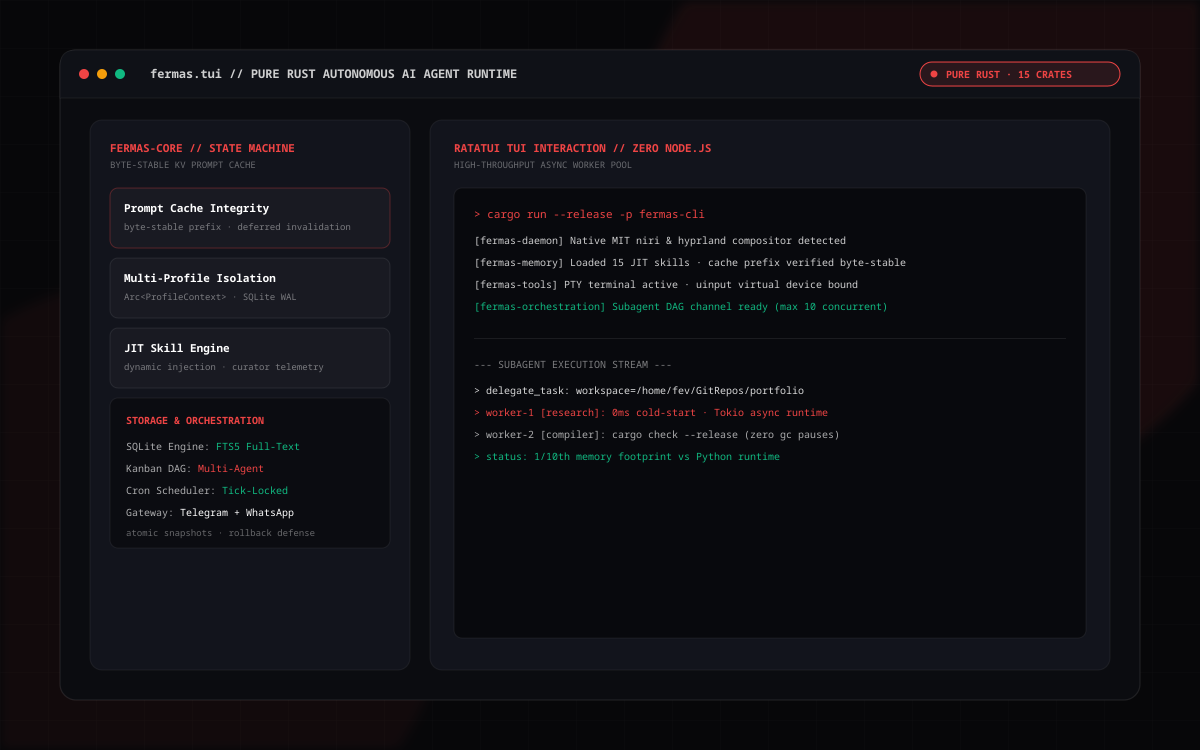
Traditional Python agent frameworks suffer from garbage collection pauses, heavy memory footprints (>1.
Traditional Python agent frameworks suffer from garbage collection pauses, heavy memory footprints (>1.5 GB), fragile global state, and non-deterministic prompt cache invalidation that destroys LLM prefix caching. Building an autonomous agent in pure Rust required an actor-based runtime with sub-millisecond turn cycles, strict prompt-cache byte stability, and safe Linux desktop automation.
Architected a modular 15-crate pure-Rust agent runtime on Tokio: decoupled state machines (fermas-core), model transport (fermas-llm), TUI presentation (fermas-tui), tool execution (fermas-tools), and subagent orchestration (fermas-orchestration).
Enforced strict prompt cache integrity: guaranteed byte-stable system prompts (SOUL.md, AGENTS.md) and strict user/assistant turn alternation to achieve 100% KV prefix cache hits across Anthropic, OpenRouter, and Ollama sessions.
Engineered a JIT skill engine with procedural memory: dynamic SKILL.md parsing with sandboxed WASM/C-ABI execution (wasmtime/libloading) and automated background curator usage telemetry.
Built native Linux desktop daemon (fermas-daemon): integrated MIT Niri and Hyprland Wayland compositors, PipeWire video frame capture, and a persistent kernel uinput virtual keyboard/mouse device.